
Background
What is HACCP?
HACCP stands for hazard analysis and critical control points. It is a practical way of managing food safety: you work out what could go wrong with the food you prepare, decide where you must keep control, check those controls are working, and put things right when they are not.
In the UK, food hygiene law requires food business operators to put in place, implement and maintain procedures based on HACCP principles. That applies to a 20-cover bistro and to a 60-site pub group alike, but the law expects the system to be proportionate. A small café does not need the same documentation as a central production kitchen.
For multi-site operators, the challenge is rarely understanding HACCP. It is making sure the same controls happen, and are recorded honestly, in every kitchen, on every shift, including the weekend when the head chef is off.
That is the part software can help with. People often search for “HACCP software”, but what A Safer Risk provides is digital monitoring and record keeping that supports your HACCP-based food safety management system, not the HACCP plan itself.
The seven principles
HACCP in plain English
HACCP is built on seven principles. Here is what each one means in a working kitchen, and which parts A Safer Risk supports.
Principle 1: Find the hazards
Work out what could make food unsafe at each step, from delivery and storage to cooking, cooling and service.
Your team or food safety adviser
Principle 2: Pick the critical points
Identify the steps where control is essential to prevent, remove or reduce a hazard. Cooking, chilling and allergen handling are common examples.
Your team or food safety adviser
Principle 3: Set the limits
Decide what safe looks like at each critical point, such as a core cooking temperature or a maximum chilled storage temperature.
Your team or food safety adviser
Principle 4: Monitor
Check those limits routinely, on every shift, and record what you found at the time you checked it.
Supported: scheduled checks
Principle 5: Put things right
Agree in advance what staff do when a check fails, and record the corrective action that was taken.
Partly supported: action tracking
Principle 6: Verify
Review records and audit the system regularly to confirm it is working, and update it when menus, suppliers or processes change.
Partly supported: audits
Principle 7: Keep records
Document the plan and keep the evidence, proportionate to your business, so you can show it is being followed.
Supported: records and documents
A Safer Risk supports monitoring and records. Hazard analysis, critical points and limits need food safety expertise.
See where A Safer Risk fits
HACCP and SFBB
How HACCP relates to Safer Food Better Business
HACCP is the principle; Safer Food, Better Business is one way of applying it.
The legal principle
HACCP
The basis UK food law asks every food business to build its food safety procedures on. A traditional HACCP plan works through hazard analysis, critical control points, critical limits, monitoring, corrective actions, verification and record keeping in detail. It needs more food safety knowledge and training than many kitchen teams have, so groups often build it with a food safety adviser.
One way to apply it
Safer Food, Better Business
The Food Standards Agency publishes the free Safer Food Better Business pack so smaller businesses in England and Wales can meet the HACCP-based requirement without writing a full plan from scratch. It is founded on HACCP principles but is not a full HACCP plan, and it works well for a single small kitchen.
If you are a single site happy with the FSA diary, you may not need a platform yet. If you are replacing paper SFBB folders across several kitchens, our digital SFBB guide covers that move in more detail.
The challenge
Why paper HACCP packs and spreadsheets struggle across sites
Paper and shared spreadsheets can work for one kitchen. Across five, twenty or a hundred sites, the same gaps open up again and again.
Paper packs and spreadsheets
- Head office can't see whether today's checks happened without phoning each site.
- Checks written up at the end of a shift, or the morning before an inspection.
- An issue is written down, but nobody records who fixed it or whether it came back.
- Old versions of the HACCP plan still in circulation after a menu or supplier change.
- Auditors and area managers spend their visits hunting for folders.
Digital checks and records
- Completion, missed tasks and overdue actions visible across every site.
- Scheduled checks with photos, notes and timestamps captured at the point of work.
- Audit findings and risk control gaps become owned, dated actions tracked to completion.
- One current, versioned copy of each procedure, with review dates and reminders.
- Structured audits and trends that roll up to a single dashboard.
Digital monitoring does not change what HACCP asks of you. It makes it easier to do consistently, and to prove when an EHO or your own leadership asks.
Early warning
How standards quietly slip, and how to spot it early
Serious food safety failures rarely start with someone ignoring the rules. They start with a missed check on a busy day, a rushed handover or an overdue action nobody chases. Each exception looks small, but repeated often enough it becomes the normal way of working. Our sister consultancy Safer Food Scores calls this compliance drift, and explains why good businesses get caught out by it (opens in a new tab).
The warning signs are usually already in your records. Growth makes them harder to see, because no single person can watch every kitchen.
- Checks completed late or after the event
- Corrective actions going overdue
- The same findings returning in audits
- Standards that depend on one manager
That is where multi-site monitoring helps. A compliance dashboard that surfaces missed tasks, overdue actions and recurring issues by site lets you look at the exceptions, not just the headline completion rate, and step in while a slipping standard is still easy to correct.

“Closing an action is not the same as resolving a problem.”
Buyer's guide
What to look for in HACCP monitoring software
Many task apps can display a checklist. Fewer support the monitoring and record-keeping side of a HACCP-based system across a group. Look for:
A register for hazards and controls
Record the hazards and controls your HACCP study identified, and review them when things change.
Scheduled monitoring
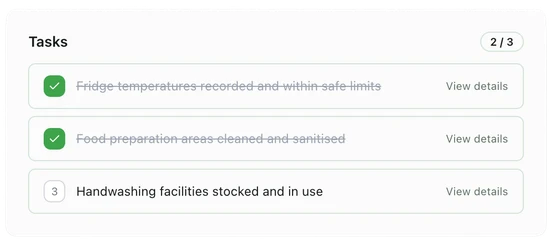
Daily, weekly and custom checks assigned to each site, with missed and overdue tasks clearly visible.
Evidence at the point of check
Photos, notes and timestamps captured on a phone or tablet where the work happens.
Action tracking
Owned, dated actions from audit findings and control gaps, followed through to completion.
Document control
Your documented HACCP plan, procedures and supplier information with versions and review dates.
Verification support
Structured audits and trend reporting, so periodic reviews are based on data rather than memory.
Multi-site visibility
Compare sites side by side without logging into each kitchen separately.
A Safer Risk brings these together for hospitality and care groups through checklists, a document store, audits, risk assessment, incident manager and a compliance dashboard.
Platform fit
Where A Safer Risk fits in your HACCP system
A Safer Risk does not write, approve or own your HACCP plan. It supports the monitoring and record-keeping parts of a HACCP-based food safety management system, with action tracking, audits and incident logging alongside. The table shows which parts stay with your team and which modules help. Explore each module on its feature page.
| HACCP need | Who or what helps | How teams use it |
|---|---|---|
| Hazard analysis, critical control points and critical limits | Your team or food safety adviser
| This is the core HACCP study. It needs food safety knowledge and training, and A Safer Risk does not do it for you. Once your plan is written, keep it versioned and review-dated in the document store. |
| Recording identified hazards, risk ratings and controls | Record hazards, score likelihood and severity, note control measures and route assessments for review and sign-off. It supports your hazard analysis; it is not a full HACCP plan. | |
| Monitoring checks | Scheduled daily, weekly or custom checks on phone or tablet, with completion tracked by site and missed or overdue tasks clearly visible. | |
| Records and documentation | Completed checks keep their photos, notes and timestamps. Policies, procedures and your documented plan are versioned, with review dates and reminders. | |
| Corrective actions and follow-up | Raise owned, dated actions from audit findings and from control gaps in risk assessments, and track them to completion. Incidents are investigated with an owner and root cause before they are closed. What staff should do when a limit is breached is still defined in your HACCP plan. | |
| Verification and periodic review | Structured, scored audits with photo evidence and trend analysis, so periodic reviews are based on real data. | |
| Complaints, near misses and food safety incidents | Log incidents quickly, investigate with owners and root cause, and spot repeat issues before they escalate. | |
| Oversight across sites | Completion rates, missed tasks, outstanding and overdue actions and recurring issues rolled up by site, so leaders can see where follow-up is slipping. |
Most groups set up checklist templates once, assign them to sites and keep the procedures staff follow in the document store. Audits and the dashboard then answer the question every operations director asks before an EHO visit: “Are we doing this everywhere?”
See all modules on the features overview, or read how Fylde Care Group runs compliance across care home kitchens.
Who it is for
Built for restaurant, pub and care home groups
A Safer Risk is designed for organisations that need the same food safety standards in every location, where catering teams must show robust controls to regulators and to their own leadership.
- Restaurant groups
- Pub companies
- Hotel kitchens
- Contract caterers
- Care home providers
Not sure which plan fits? Book a demo and we will walk through your sites, or start a free trial to try checklists and documents on your own data.
Core
£69
per site, per month
Checklists, document management and compliance visibility.
Professional
£149
per site, per month
Adds deeper audit and reporting for formal scored inspections.
Prices on a 12-month contract. Per-site pricing scales with your estate. Compare plans on the pricing page.
FAQ
HACCP, EHOs and UK food law
- Is HACCP a legal requirement for UK food businesses?
- UK food hygiene law requires food business operators to put in place, implement and maintain a permanent procedure based on HACCP principles. The law allows flexibility, so the system should be proportionate to the size of the business and the food it handles. Smaller businesses often meet the requirement using the FSA's Safer Food, Better Business pack in England and Wales, CookSafe in Scotland or Safe Catering in Northern Ireland. Larger and multi-site operators usually document their own system. Your local authority is the best place to confirm what is expected for your premises.
- Will an EHO accept digital HACCP records?
- UK law does not require HACCP records to be kept on paper, and many operators keep them digitally. Environmental health officers look for evidence that your food safety procedures are understood and followed in practice: hazards identified, controls in place, monitoring recorded, problems corrected and the system reviewed. Software helps you produce that evidence consistently, but it does not replace your legal duty to manage food safety. If you are moving from an established paper system, we recommend discussing the change with your local authority.
- What is the difference between HACCP and Safer Food Better Business?
- HACCP (hazard analysis and critical control points) is the set of principles that UK food law asks businesses to base their food safety procedures on. Safer Food, Better Business is a free pack from the Food Standards Agency that helps smaller businesses apply those principles without writing a full HACCP plan. SFBB is one way of meeting the HACCP-based requirement, not a separate law. Neither SFBB nor the food safety management system Safer Food Scores provides contains a traditional, risk-assessment-style HACCP plan. A full HACCP plan is more detailed and needs more food safety knowledge and training. Multi-site groups often outgrow the paper pack and move the day-to-day checks and records into software.
- Does A Safer Risk write or manage my HACCP plan?
- No. A Safer Risk is not HACCP plan software and does not write, approve or take ownership of your HACCP plan. Hazard analysis, identifying critical control points, setting critical limits, deciding corrective action procedures, and verifying and reviewing the system all need people who understand your menus, processes and premises, with competent food safety advice where needed. A Safer Risk supports the monitoring and record-keeping parts of a HACCP-based food safety management system: scheduled checks, evidence, action tracking, audits, incident logging and a place to store your documented plan. If you need help building the plan itself, our sister consultancy Safer Food Scores provides HACCP, training and documentation support.
- Is digital HACCP monitoring suitable for care home kitchens?
- Yes. Care home kitchens follow the same HACCP-based food hygiene law as restaurants, and often serve vulnerable residents, so consistent evidence matters to EHOs and to the provider's own quality teams. Digital checklists, documents and audits let a care group see how every home's kitchen is performing without collecting folders from each site.
- How much does A Safer Risk cost for HACCP monitoring?
- Core is £69 per site per month on a 12-month contract, and Professional is £149 per site per month. Plans include checklists, document management and compliance visibility, with Professional adding deeper audit and reporting capability. Compare modules on the pricing page or book a demo to match a plan to your sites.
Next step
Consistent HACCP checks, every site
See how checklists, documents, audits and action tracking support the monitoring and records in your HACCP system, on a demo or in a free trial.