
What's in the pack
Six food safety record sheets, ready to print
Each sheet covers one week for one site, so records stay easy to check and easy to compare. A start-here page sets out the key UK temperature limits.
- Sheet 01 | Daily
Daily opening and closing checks
A weekly grid for safe start-up and shut-down: equipment, staff fitness for work, pests, hand basins, use-by dates, allergen information and end-of-day storage.
- Sheet 02 | Twice daily
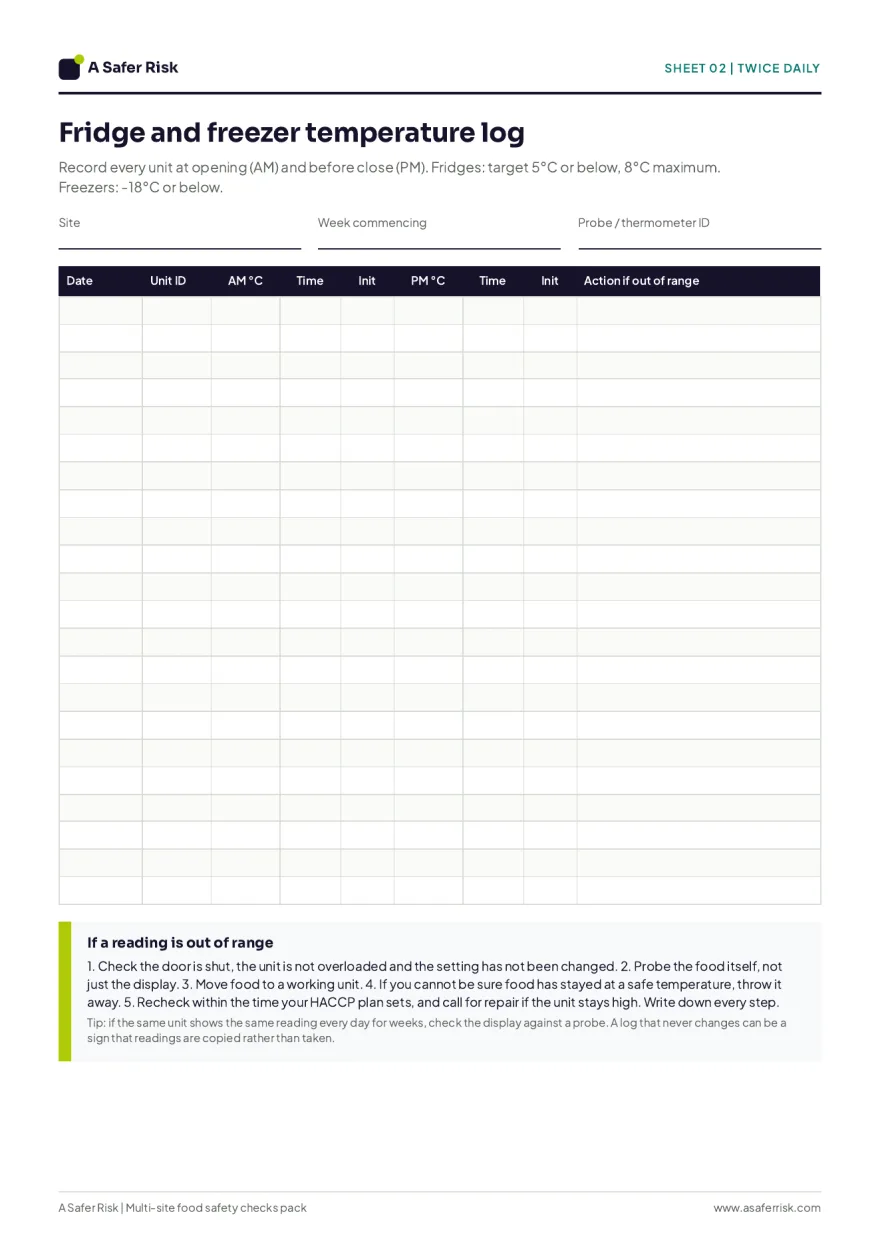
Fridge and freezer temperature log
AM and PM readings for every unit, with the probe ID, initials and the action taken if a reading is out of range.
- Sheet 03 | Every batch
Cooking, cooling and reheating log
Core temperatures for cooking and reheating, cooling start and finish times, and hot holding checks at 63°C or above.
- Sheet 04 | Daily and weekly
Cleaning schedule
What to clean, how often and with which product, from prep surfaces and probes to extraction filters, with a two-stage clean for food contact surfaces.
- Sheet 05 | Weekly
Weekly manager review
A ten-minute review that checks records are complete and real, closes last week's actions and adds an area manager countersign for multi-site groups.
- Sheet 06 | Ops and area managers
Commonly missed checks across sites
The checks that tend to slip, the warning signs in paper records and a weekly cross-site view to compare every kitchen side by side.
Key temperature limits (UK)
The limits every sheet is built around
Use these targets unless your own HACCP plan sets stricter ones. The pack explains where Scotland differs and how to check your probe thermometer.
- 5°C
Fridges and chilled food
Or below. 8°C is the legal maximum in England, Wales and NI.
- -18°C
Freezers
Or below. Food should be frozen solid.
- 75°C
Cooking
Core temperature, or an equivalent such as 70°C for 2 minutes.
- 63°C
Hot holding
Or above. Scotland: above 63°C.
- 90 min
Cooling
Cool as quickly as possible, ideally within 90 minutes.
- 75°C / 82°C
Reheating
75°C core in England, Wales and NI. At least 82°C in Scotland.
Sources: FSA Safer Food, Better Business; Food Standards Scotland CookSafe; Food Safety and Hygiene (England) Regulations 2013; Food Hygiene (Scotland) Regulations 2006.
Sheet 06 for ops managers
The checks that get missed across sites
Paper records rarely fail in obvious ways. They fail quietly, in the same places, and they are hard to compare across sites. The final sheet helps area and ops managers spot it.
Checks that tend to slip
- End-of-shift checks, such as closing checks and PM fridge readings
- Checks that need a probe: cooling, reheating and hot holding
- Less frequent tasks like weekly cleaning and probe calibration
- Cover days: weekends, bank holidays and when the usual manager is off
- Checks that rely on a new starter knowing the routine
Warning signs in the records
- The same reading every day, on every unit, all month
- Round or identical times, such as 09:00 on the dot
- A whole week filled in with the same pen, all at once
- No out-of-range readings or corrective actions, ever
- Cooling records with a start time but no end time
The sheet ends with a weekly cross-site view, so you can score every kitchen as complete, partial or missing in one table. Two weeks of "partial" in the same column at the same site is a pattern, not a one-off.
How to use it
Print one set per site, per week
Keep completed sheets with your SFBB pack or HACCP plan, so they are ready for your Environmental Health Officer (EHO) and, for care homes, your care regulator.
Set your limits
Use the UK targets in the pack unless your own HACCP plan sets stricter ones.
Name each unit
Give every fridge, freezer and hot holding unit a short ID, such as F1 or FZ2.
Record the action
An out-of-range reading with a clear corrective action is good evidence. A blank is not.
Review weekly
The manager review and the cross-site sheet turn records into decisions.
FAQ
Food safety checklist questions
- Is the food safety checklist pack really free?
- Yes. Fill in a few details and the PDF downloads straight away, with no charge and no account to set up. You are free to print it, copy it and use it in as many kitchens as you like.
- Does this pack replace Safer Food, Better Business or my HACCP plan?
- No. The record sheets are built around FSA Safer Food, Better Business (SFBB), Food Standards Scotland CookSafe and HACCP principles, and are designed to sit alongside your existing food safety management system. They do not replace it. Keep completed sheets with your SFBB pack or HACCP plan, and always follow the limits in your own plan where they are stricter.
- Which temperatures does the pack use?
- The pack uses common UK limits: fridges at 5°C or below (8°C is the legal maximum for chilled food in England, Wales and Northern Ireland), freezers at -18°C or below, cooking to 75°C core or an equivalent time and temperature, hot holding at 63°C or above, cooling within 90 minutes, and reheating to 75°C core (at least 82°C in Scotland unless this would spoil the food).
- Can I use the pack in Scotland or Northern Ireland?
- Yes. The key limits page notes where Scotland differs, for example the 82°C reheating requirement and CookSafe's advice to keep chilled food at 5°C or below. Northern Ireland businesses can also use the FSA's Safe Catering pack alongside these sheets.
- Is the pack suitable for care home kitchens?
- Yes. The pack is written for hospitality groups and care homes running more than one kitchen. The cooking and cooling sheet includes a note for care homes, where residents may be more vulnerable to food poisoning. Read more about food safety records in care homes on our care home food safety page.
- How often should the sheets be filled in?
- Opening and closing checks are daily, fridge and freezer readings are taken twice a day, cooking, cooling and reheating are logged for every batch, the cleaning schedule covers daily and weekly tasks, and the manager review takes about ten minutes once a week. Print one set per site, per week.
This pack is a general aid based on FSA Safer Food, Better Business, Food Standards Scotland CookSafe and HACCP principles. It does not replace your own food safety management system or advice from your local authority.
Paper works
Until you have ten sites
A Safer Risk turns these sheets into digital checks and temperature logs, flags missed checks per site and tracks audit actions through to close.