
Food safety articles
What Does FIFO Stand For? First In, First Out in Food Safety
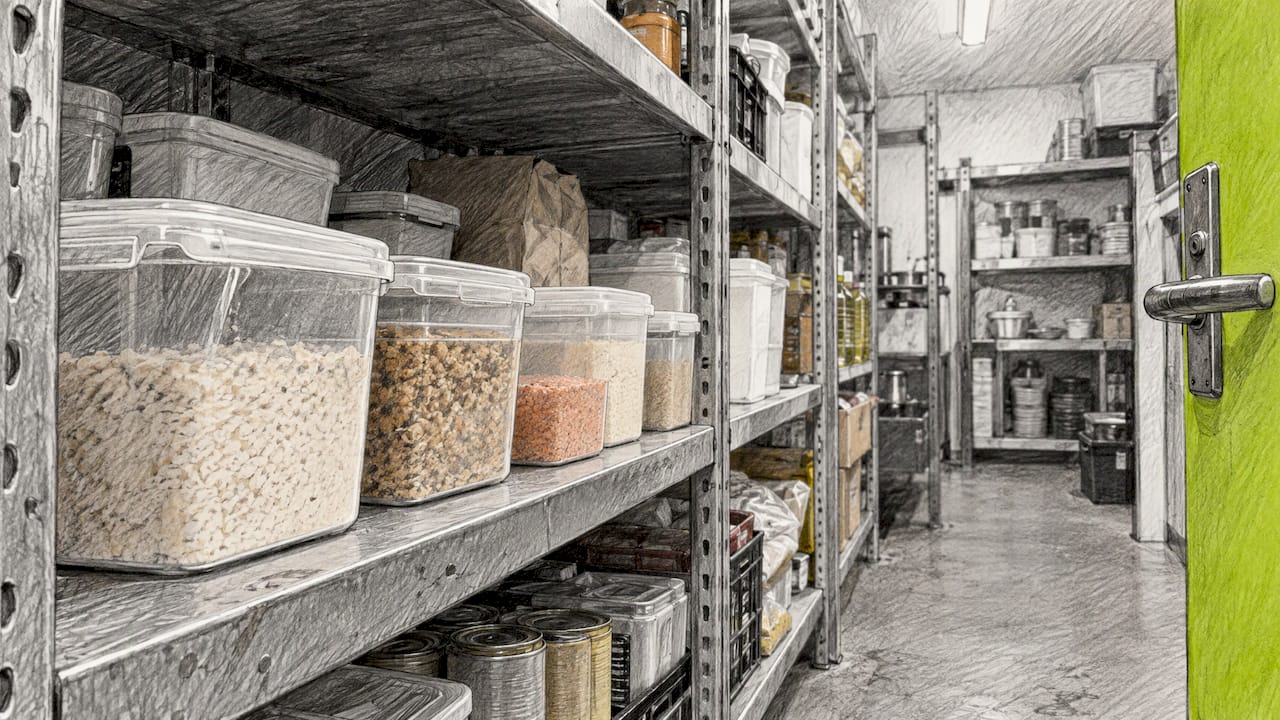
FIFO stands for first in, first out. In a kitchen, care home or school canteen it means the food that arrived first is the food you use first, so older stock never gets buried behind newer deliveries. The rule is simple. The hard part is doing it the same way on every shift and every site, and being able to show an inspector that you did. This guide explains the term, how to apply it from delivery to service, and how multi-site operators keep it consistent.

TL;DR
- FIFO means first in, first out: use the oldest stock first, and put new stock behind it.
- The Food Standards Agency (FSA) tells caterers to follow it and to train staff in stock control.
- FIFO is about order of use. The date on the label still decides whether food can be used at all: a use by date is a legal limit.
- It only works with clear labelling, delivery checks and regular stock checks that someone records.
- Digital checklists with corrective actions let a group see missed rotation checks across every site.
Table of Contents
- What FIFO stands for, and where else you will see it
- What first in, first out means on the shelf
- FIFO and dates: what the law actually says
- Putting FIFO into practice, step by step
- Why FIFO is easy to say and hard to prove
- How to make FIFO checks consistent across sites
- FIFO in different settings
- What we think about FIFO
- Bringing FIFO checks into one system
- FAQ
- Sources
What FIFO stands for, and where else you will see it
In food storage and stock control, FIFO is short for first in, first out. The food that has been on your premises longest goes out first, whether that means to the pass, to a customer or to the bin if it has expired.
The same letters have other meanings, which is why the search results are mixed. In Australia and some other markets, FIFO also means fly-in fly-out, a work pattern where staff are flown to remote sites such as mines. In accounting, FIFO is a way of valuing inventory that assumes the oldest items were sold first. This article covers the food safety meaning, which is the one that matters to a restaurant, hospital kitchen, school or care home.
What first in, first out means on the shelf
The FSA’s Safer Food, Better Business guidance for caterers tells businesses to follow the first in, first out system of stock rotation so that older stock is used first, which helps avoid waste. It also says to train staff in stock control so they know the order in which to use foods, to carry out regular stock checks and to throw away anything past its use by date.
In practice that looks like this:
- Fridges and freezers: items with the earliest date sit at the front or on top. New deliveries go behind or underneath.
- Dry stores: the same principle. New cases go to the back, older ones come forward.
- Decanted food: Food Standards Scotland’s stock control guidance says existing stock should not be topped up with new stock. Use up what is in the container first. It also says decanted dried food should be labelled and kept in pest-proof, waterproof containers.
A common variation is “first expired, first out”. Durham University’s HACCP stock control card recommends using food that will expire before food with a longer time left. That matters because a later delivery can sometimes carry an earlier date than the stock already on the shelf. Rotate by date, not just by arrival.
FIFO and dates: what the law actually says
FIFO tells you the order of use. Date labels tell you when food must stop being used. The two work together, and staff need to know the difference.
| Label | What it means | Can you use it after the date? |
|---|---|---|
| Use by | A safety date, on high-risk food that could cause food poisoning | No. It is against the law |
| Best before | A quality guide: flavour, texture, freshness | Yes, if the food is still in good condition |
That distinction comes from London Borough of Bromley’s storage guidance. The FSA’s guidance for caterers is just as plain: it is against the law to serve food after its use by date because it might not be safe to eat. Food that looks and smells fine can still be unsafe.
UKHospitality’s 2026 EHO checklist says environmental health officers (EHOs, the council inspectors who check food businesses) look in fridges, freezers and dry stores for food past its use by date. It describes selling or using such food as a criminal offence. It adds that selling past a best before date is not illegal if the food is safe, but a lot of past-date items can raise concerns about how you manage stock. EHOs also check that older stock is being used before newer products.
Durham University’s card makes the same point from the kitchen side: having food on the premises with an expired use by date is an offence.
Putting FIFO into practice, step by step
FIFO is won or lost at four points: delivery, labelling, storage and the daily check. Here is what each takes and where it tends to go wrong.
1. Check stock when it arrives
The SFBB guidance asks you to check every delivery: is it within its use by date, cold enough, not gone off, and clean and undamaged? Throw away punctured vacuum packs, swollen packs and badly dented cans. West Norfolk Council’s shelf life and stock rotation advice likewise lists checking use by and best before dates at the point of delivery.
Where it goes wrong: deliveries land during a busy service, so the check is skipped and short-dated stock goes straight to the back of a shelf.
2. Label so the date is obvious
Durham’s card says pre-packed food needs a product description, weight or quantity, storage instructions and a use by or best before date. Food you prepare in-house more than 24 hours before use should carry the product description and the production date.
For prepared chilled food, West Norfolk’s advice is to use it within the shortest shelf life of any ingredient, or apply a 3-day limit including the day it was made. It suggests a 1-month shelf life for frozen food, whether bought or prepared. It names stock books, coloured day dots and date labels as ways to document shelf life.

Where it goes wrong: the FSA warns that if labelling on frozen food is unclear, new stock might be used before old stock. FIFO fails quietly when labels are missing or unreadable.
3. Store so the oldest is easiest to reach
Put older or shorter-dated items at the front and new ones behind. Storage conditions matter as much as order. UKHospitality notes EHOs expect storage to be clean, tidy and organised, with raw food kept away from cooked and ready-to-eat food. Chilled food should be at 8°C or below and frozen food at -18°C or colder. Food should be off the floor, in proper containers and fully covered.
Where it goes wrong: a full fridge on a Friday. New stock is squeezed in wherever it fits and the rotation order disappears.
4. Check, separate and dispose
The SFBB guidance advises a stock check before placing an order, and planning stock for each shift. West Norfolk’s six-step checklist adds daily checks for out-of-date food, immediate disposal or separation of past-date items, a written stock rotation procedure and staff training on it. Expired use by food being held for return to a supplier should be kept apart and clearly marked “not for sale” or “do not use”.
Where it goes wrong: the check is done but not written down, so no one can show when it happened or who dealt with a problem.
Why FIFO is easy to say and hard to prove
On one site with one head chef, rotation can run on habit. Across several sites, three things get in the way:
- Inconsistent checking. One kitchen checks dates at opening, another only when the manager remembers.
- Paper records. Stock checks are on clipboards that are filled in late or lost, and compiling them for a report is slow.
- No follow-through. A past-date item is found and binned, but nobody records why it happened or whether it keeps happening in the same store.
Inspectors read the same signals. UKHospitality makes the point that out-of-date items found during a visit point to weak management of stock. The question is not only whether FIFO is in your procedure, but whether you can show it is being done and that problems get fixed.
How to make FIFO checks consistent across sites
A reliable routine has a few parts, whatever tools you use:
- Write the procedure once. Define how stock is received, labelled, stored and checked, and keep the document where every site can find the current version.
- Tie the checks to the shift. Put the rotation and date check into opening and closing routines, not into an occasional audit.
- Record the result with evidence. A tick, a time, a name and, where useful, a photo.
- Turn a failure into an action. If out-of-date food is found, someone is assigned to deal with it and the action is closed.
- Look at the pattern. Group managers should see which sites keep missing checks, and which issues keep coming back.
This is the gap our platform is built for: it connects procedures, monitoring and corrective actions, so that a missed check is visible rather than discovered at inspection. Our digital food safety checklists take the place of paper sheets, and the compliance dashboard gives group-wide visibility of overdue work and recurring issues. If missed checks are your main worry, our page on missed food safety checks across sites goes into it in more detail. For the document side, document control keeps your written procedures in one place.
Our HACCP monitoring software supports HACCP and SFBB, the two legal food safety management models most UK caterers work to. HACCP stands for Hazard Analysis and Critical Control Points, a method of identifying and controlling the points where food could become unsafe. Stock rotation and date control sit comfortably inside either one. If you want to understand how those pieces fit together, our guide to the food safety management system is a good next read.
FIFO in different settings
Restaurants, pubs and hotels. High turnover and many suppliers mean frequent deliveries and crowded fridges. Fast, shift-based checks matter most. See our software for restaurants, pubs and hotels.
Care homes and healthcare. Residents can be more vulnerable to foodborne illness, so date control and clear records carry extra weight. Our care home food safety software is built with that setting in mind.
Schools and educational catering. Kitchens are often small teams working to fixed service times, with deliveries before the day starts. A short, consistent opening check and a recorded result suit this pattern.

Multi-site groups. The challenge is sameness: every kitchen doing the check the same way, and head office seeing the results without chasing.
What we think about FIFO
FIFO is one of the first things we teach a new kitchen team, and one of the first things to slip when the team is busy. The rule is not complicated. What goes wrong is that nobody sees the slip until an inspector, or a customer, does.
Our view is that the useful question is not “do we have a FIFO policy?” but “can we see, today, which sites checked their dates and which did not?” That is why we built the platform around connecting procedures, monitoring and corrective actions, so a missed check becomes an action with an owner instead of a gap in a folder.
For multi-site operators, group-wide dashboards that show overdue work and recurring issues turn rotation from a good intention into something you can manage. With modules built around HACCP and SFBB, the checks your team already does map onto the legal models you work to, with less paperwork.
Darragh
Bringing FIFO checks into one system
If you run more than one kitchen, the quickest gain is replacing paper stock checks with recorded, shift-based ones that flag what is overdue. Our platform pricing is per site, per month: Core is £69, Professional is £149 and Complete is £199, and a separate Audit service is £40 per month. You can compare the plans on our pricing page, or book a demo to see how stock and date checks would look across your sites.

If you want a starting point first, our free food safety checklist pack is a UK PDF, and our food safety guides cover related routines.
FAQ
What does FIFO stand for in food safety?
FIFO stands for first in, first out. It means using the oldest stock first and storing new deliveries behind older ones. The FSA’s SFBB guidance tells caterers to follow it so older stock is used first and waste is reduced.
Is FIFO a legal requirement?
The law sets the date rules rather than the method. Serving or selling food after its use by date is against the law, and EHOs check that older stock is used before newer stock. FIFO is the standard way caterers keep within those rules and the FSA guidance tells them to follow it.
Can I use food after its best before date?
Best before is a quality guide, not a safety limit, so food can still be used past it if it is in good condition. Use by is different: food must not be used after that date. Staff should be trained to tell the two labels apart.
What is the difference between FIFO and FEFO?
FIFO rotates by arrival order. FEFO, first expired, first out, rotates by the date on the label, so the item that expires soonest is used first even if it arrived later. Durham University’s stock control card recommends the first expired approach, and in many kitchens the two are used together.
Does FIFO also mean fly-in fly-out?
Yes, in a different context. Fly-in fly-out is a work arrangement common in Australian mining and energy, where staff are flown to remote sites for shifts. In food safety, FIFO always means first in, first out.
Sources
- Safer Food Better Business for Caterers: stock control (FSA)
- Stock control guidance (Food Standards Scotland)
- Effective stock control and rotation HACCP card (Durham University)
- Storage in your food business (London Borough of Bromley)
- The 2026 EHO checklist (UKHospitality)
- Shelf life and stock rotation advice (West Norfolk Council)