
Food safety articles
Food Safety Management System: What UK Businesses Need
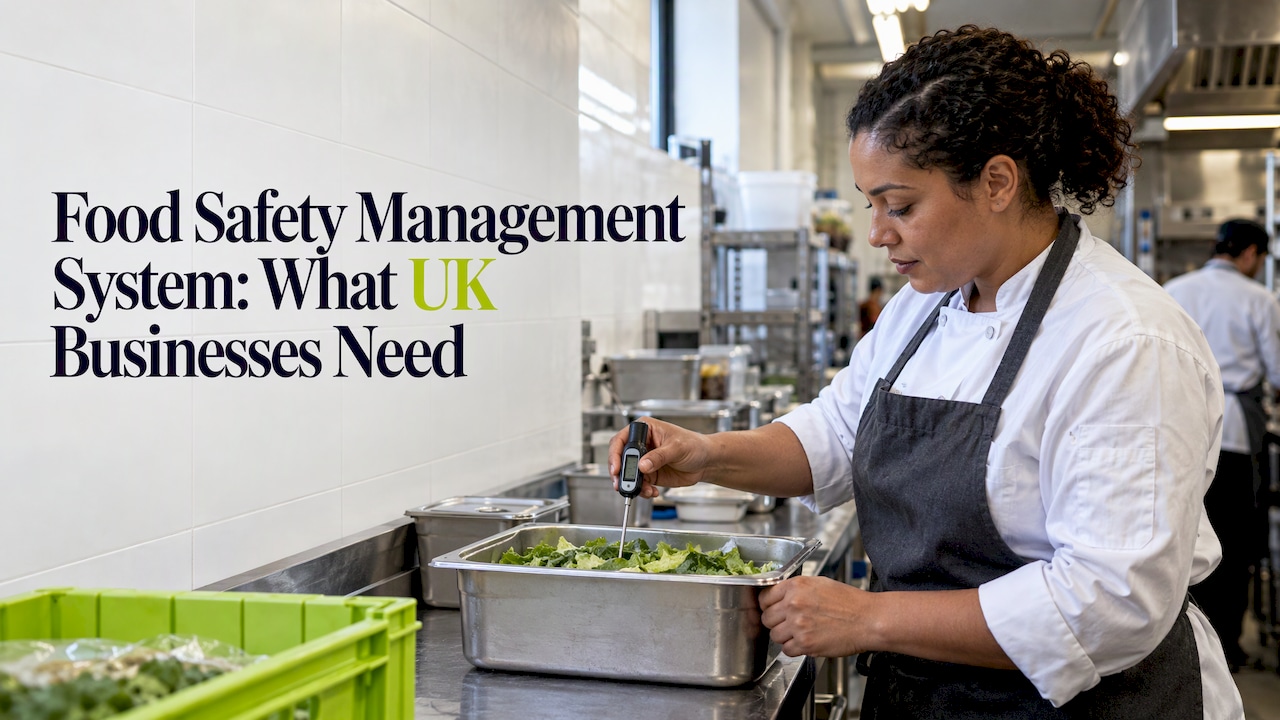
A food safety management system (FSMS) is the written set of procedures, checks and records that shows how your business keeps food safe. In the UK, every food business needs one, and it must be based on HACCP principles. This guide explains what goes into it, what the law expects, how to set it up and review it, and how to keep it working across several sites.
TL;DR
- An FSMS is your documented way of controlling hazards: hygiene, cooking, storage, allergens, training and temperature checks, plus the records that prove it.
- UK law requires procedures based on HACCP principles, with documents and records proportionate to the size and nature of the business.
- The system only works if it is used every day and reviewed when menus, suppliers, equipment or key staff change.
- Across multiple sites, the hard part is consistency: knowing which checks were missed and which problems keep coming back.
- A digital system links procedures, monitoring and corrective actions so that gaps are visible to managers straight away.
Table of Contents
- What a food safety management system is
- What UK law requires
- The main elements of a HACCP-based system
- What records to keep
- How to set up, document and review your system
- Paper or digital: what to check before you choose
- Running one system across several sites
- Our perspective
- See it on your own sites
- FAQ
- Sources
What a food safety management system is
An FSMS is a written set of processes, checks, rules and records used to keep food safe. GOV.UK describes it as typically covering cleaning and hygiene, cooking and storage, allergens, staff training and temperature checks.
It is not a single document you write once and file away. It is the working routine of your kitchen or site: what staff do, how you check they did it, what happens when something goes wrong, and the evidence you keep.
Food safety management also reaches beyond the kitchen door. GOV.UK guidance says it must consider suppliers, traceability of food bought and supplied to other businesses, and transport.
What UK law requires
The legal basis is Article 5 of Regulation (EC) No 852/2004, as it applies in the UK. It requires relevant food business operators to put in place, implement and maintain permanent procedures based on HACCP principles. Documents and records must be commensurate with the nature and size of the business.
The current GOV.UK guidance for England, Northern Ireland and Wales adds three practical points:
- use procedures based on HACCP principles;
- keep documents and records current;
- review procedures so they reflect how you actually produce food and work today.
The same guidance says that very simple processes may not need formal procedures beyond good hygiene practice, and suggests contacting your local authority if you are unsure where you stand.
Which system applies where you are
The official routes differ by nation:
| Nation | Official starting point |
|---|---|
| England and Wales | Safer Food, Better Business (SFBB) for many caterers, or a system built on HACCP principles |
| Northern Ireland | Safe Catering, the Food Standards Agency guide for caterers and retailers, with recording forms and sector resources |
| Scotland | CookSafe for most caterers, RetailSafe for retailers handling unwrapped high-risk food, and ButcherSafe for raw and ready-to-eat foods |
In Scotland, operators must also review and update the system after changes or at least annually, keep monitoring records and record staff training at induction and at each review. Food Standards Scotland also offers a free MyHACCP tool that guides manufacturers through an HACCP-based system.
If you run SFBB in a UK kitchen, our page on the SFBB app for UK kitchens shows how the pack can be run digitally.
The main elements of a HACCP-based system
HACCP is, in GOV.UK’s words, a system for identifying potential food hazards and introducing procedures to remove them or reduce them to an acceptable level. The official overview boils it down to five jobs:
- Identify food hazards and the critical control points (CCPs) where you can control them.
- Set limits for each CCP and monitor them.
- Check that the system works.
- Put things right when a CCP goes wrong.
- Keep records of the system, the checks and the corrective actions.
A council example makes this concrete. Torbay Council’s model starts by mapping each process step, then identifying hazards, selecting controls, setting monitoring procedures and safe limits, defining corrective actions, identifying the essential CCPs, verifying and reviewing, and documenting records.
A worked example: chilled delivery arrives at a restaurant. The hazard is bacterial growth if the food is too warm. The control is a temperature check on arrival, with a limit set in your procedure. The monitoring is the reading logged by whoever receives the delivery. The corrective action is what happens if it fails, such as rejecting the batch and noting the supplier. The record is the log entry showing all of this. Every part of the system follows that same chain: hazard, control, check, fix, evidence.

GOV.UK also notes that a local food safety team might advise a larger or higher-risk business to have a full HACCP plan, so bigger operators should expect that conversation.
What records to keep
The records are what turn good practice into a system an inspector can see. Torbay Council lists the FSMS itself, training, cleaning, temperatures, pest control, personal hygiene, suppliers and customers, equipment maintenance, problems and corrective actions, and allergen procedures or matrices.
Traceability has its own requirements. GOV.UK says records must cover suppliers and the businesses you supply, including names and addresses, product types and quantities, and transaction and delivery dates. Batch numbers, invoices and receipts may also be kept.
GOV.UK also provides templates that can cover cleaning, maintenance, pest control, chemical records, staff training, staff hygiene, and staff health and sickness. If you want ready-made forms to start from, our free food safety checklist pack is a practical place to begin.
How to set up, document and review your system
The official route is straightforward. Contact your local food safety team, build your system using guidance and templates or independent advice, then check, review and update it regularly and whenever food processes or suppliers change.
A sensible order for a new site:
- Map what you do. List the menu, the processes and the equipment, from delivery to service.
- Identify hazards and controls. Cover allergens, cross-contamination, cooking, chilling, hot holding and cleaning.
- Write down the safe methods. Keep them short enough that staff will read them.
- Set up the daily checks. Decide who checks what, and when.
- Decide corrective actions in advance. Staff should know what to do before the fridge fails.
- Train and record it. Log training at induction and at each review.
- Review on a schedule and on triggers.
Reviewing: when and how often
The Food Standards Agency’s Safer Food, Better Business caterers pack says safe-method sheets should be completed before operations start, reviewed regularly and updated when operations change. Its diary records daily events and problems, with a four-weekly review to spot persistent issues.
Torbay Council gives review triggers: a new menu or product, new equipment, structural alterations and changes in key staff. It recommends an annual review, or a review whenever something changes.
The four-weekly review is the habit that matters most. It is where you ask what keeps going wrong, rather than only whether today’s boxes were ticked.
Paper or digital: what to check before you choose
Paper works for one small kitchen with a steady team. The cost shows up as you grow: diaries get lost, entries are filled in late, and a manager has to walk round or collect folders to see what is happening. Reporting becomes manual and slow.
A digital FSMS keeps the same HACCP logic but changes how it runs. Checks are assigned and timed, records are captured at the point of work, and problems are visible as they happen. Before adopting one, use this checklist:
| Question | Why it matters |
|---|---|
| Does it follow the model you use (HACCP, SFBB, Safe Catering, CookSafe)? | The system must match your legal basis, not replace it |
| Does it link a failed check to a corrective action? | Finding a problem is half the job; closing it is the other half |
| Can you see overdue work across all sites in one place? | Group managers need to act on gaps early |
| Can staff capture evidence such as photos and notes quickly? | Records are only useful if they are filled in at the time |
| Does it handle incidents, policies and audits as well as checklists? | One system is easier to keep current than four |
| Is pricing clear per site? | Costs should scale predictably as you add sites |
Our features page shows how each of these is covered on our platform, and the HACCP monitoring software page goes into the monitoring side.
Running one system across several sites
Multi-site operators usually meet the same three problems: checks done differently at each site, no quick way to see what has been missed, and reports that take hours to compile. The fix is not a longer manual. It is one standard, applied everywhere, with visibility on top.
What helps in practice:
- One set of checklists and procedures for every site, adjusted only where the operation truly differs, such as a care home kitchen against a pub.
- Clear ownership. Every check and every corrective action has a named person and a deadline.
- A group view. Overdue work and repeat problems should show up without anyone chasing for them.
- A regular pattern review. The same fridge, the same shift or the same supplier appearing again and again points to a root cause.
- Evidence on file. Photos, notes and audit results sit with the record, ready for an inspection.
If missed checks are your main headache, see our guide to missed food safety checks across sites. For a sector example, our hospitality group case study shows the approach at work, and our page for care homes covers the particular needs of residential settings.
Our perspective
We built A Safer Risk around one idea: a food safety system should connect procedures, monitoring and corrective actions, so that nothing sits in a gap between them.
In most multi-site businesses we see, the procedures exist and the staff are willing. What is missing is a clear, current picture of what has been done, what has not, and what keeps recurring. Managers end up compiling reports by hand when they should be deciding what to fix first.
Our platform is designed to give that picture: group-wide dashboards that highlight overdue work and recurring issues, with modules built for the UK legal models, HACCP and SFBB. The aim is less paperwork, more accountability, and a site that is ready for the inspector on any ordinary day.
Darragh
See it on your own sites
A Safer Risk is a food safety management platform with digital checklists, compliance dashboards, risk assessment tools, incident logging, policy management, audit tracking, evidence capture and corrective action management. Pricing is per site, per month, as published on our pricing page: Core is £69, Professional is £149 and Complete is £199. Audits are available as an add-on at £40 per month.

If you run restaurants, pubs or hotels, start with our food safety software for hospitality. You can look at the compliance dashboard to see how overdue work and recurring issues are shown, or visit asaferrisk.com to book a demo or start a trial.
FAQ
Is a food safety management system a legal requirement in the UK?
Yes. GOV.UK states that every food business needs one, and that it must meet HACCP principles. Very simple processes may need little beyond good hygiene practice, so ask your local authority if you are unsure.
Is HACCP the same as a food safety management system?
Not quite. HACCP is the method for identifying hazards and controlling them. The FSMS is the wider system around it: the procedures, training, cleaning, supplier controls, monitoring and records that put HACCP into daily practice.
How often should I review my system?
Review it at least annually and whenever something changes, such as a new menu, new equipment, a new supplier or a change in key staff. The Food Standards Agency’s SFBB pack also suggests a four-weekly diary review to catch persistent problems.
What records do inspectors expect to see?
Expect to show your written system, training, cleaning, temperature and pest control records, supplier and traceability information, and any problems with the corrective actions taken. The exact set depends on your business and which official system you follow.
Can a digital system replace SFBB or HACCP?
No, and it should not try to. A digital system runs your chosen model: it holds the checks, assigns the work, captures records and tracks corrective actions. Your legal basis stays HACCP principles, whether you use SFBB, Safe Catering, CookSafe or your own plan.
Sources
- Food safety management systems for businesses: Overview, GOV.UK
- Food safety management systems for businesses: Creating a food safety management system, GOV.UK
- Managing food safety, GOV.UK
- Regulation (EC) No 852/2004, Article 5, legislation.gov.uk
- Safe catering, GOV.UK
- Safer Food, Better Business for caterers, Food Standards Agency
- Food safety management systems, Falkirk Council
- Local authority guidance and training, Food Standards Scotland